
Leak Sealing & Clamping
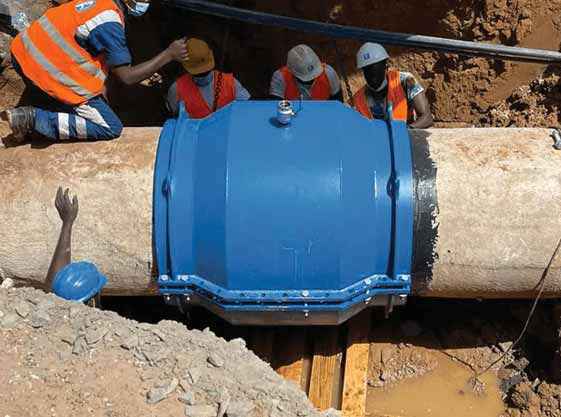
Enclosure and saddle clamps engineered to the pipe OD, the medium and the pressure, sealing pinholes, cracks and corroded patches without cutting the line open.
Leak sealing, clamping, sleeving and full line restoration — carried out on site or in our works, with the aim of getting the line back in service before the loss becomes a shutdown.
Every hour a line leaks costs product, energy and — where the medium is hazardous — risk that grows the longer it is tolerated. Our repair service exists to close that gap quickly and properly, rather than with a temporary wrap that has to be redone at the next opportunity.
We assess the defect first: what failed, why it failed, and whether the surrounding metal is still sound. Only then do we choose the method — an enclosure clamp, a welded sleeve, a cut-out and replacement spool, or a full section renewal. The wrong method applied fast is a second failure waiting to happen.
From a pinhole on a utility header to the renewal of a corroded section of process line.
Enclosure and saddle clamps engineered to the pipe OD, the medium and the pressure, sealing pinholes, cracks and corroded patches without cutting the line open.
Split repair sleeves fitted over the defect and welded or bolted in place, restoring wall strength across a wasted length rather than at a single point.
Where the wall is too far gone to repair, the section is cut out and a new spool — made to the measured dimensions in our works — is welded in.
Qualified welders for CS, SS and alloy steel, with preheat and post-weld heat treatment where the material and thickness demand it.
Many repeat failures are a support problem, not a pipe problem. We reset hangers, slide plates and guides so the repaired section is not loaded the same way again.
Thickness survey around the defect, weld inspection after repair, and a written record of what was found and what was done.
Five steps, in this order, every time — the assessment is never skipped to save an hour.
Line size, material, medium, pressure, temperature and a photograph of the defect are enough for us to advise on method and mobilisation.
Thickness readings around the leak establish how far the wastage extends — which is almost always further than the visible mark.
The clamp, sleeve or spool is made in our works to the measured dimensions, in the matching material grade.
Fitting and welding on site or in the workshop, under the permit conditions and safety requirements of the plant.
Leak or pressure test as agreed, weld inspection, and a written repair record issued with the job.
Which method suits which defect — and what each one can and cannot do.
Swipe the table sideways to see all columns.
| Method | Best For | Size Range | Line Shutdown |
|---|---|---|---|
| Leak Repair Clamp | Pinholes, cracks, local corrosion | 15 mm to 1200 mm NB | Not always required |
| Saddle / Encirclement Clamp | Branch and weld-neck leaks | 50 mm to 900 mm NB | Not always required |
| Bolted Repair Sleeve | Wasted lengths, external damage | 50 mm to 1200 mm NB | Not always required |
| Welded Repair Sleeve | Structural restoration of a wasted section | 50 mm to 1500 mm NB | Required |
| Cut-Out & New Spool | Wall loss beyond repair limits | 15 mm to 1500 mm NB | Required |
| Weld Overlay / Build-Up | Local pitting on thick wall | Any | Required |
Whether a live repair is possible depends on the medium, pressure and temperature at the defect — that call is made on assessment, never in advance over the phone.
The four things we are asked every time a line starts leaking.
Pipe size and material, the medium in the line, operating pressure and temperature, a photograph of the leak, and the location. That is enough for us to recommend a method and tell you what we would bring.
Often, yes — a bolted clamp or sleeve can be fitted on a live line within the pressure and temperature limits of the design. Anything that involves welding or cutting the parent pipe needs the line drained, isolated and made safe first.
An engineered clamp designed for the line's pressure class is a long-term repair, not a patch — but it is still a repair. Where corrosion is general rather than local, we will say so and recommend replacing the section at the next planned shutdown.
Yes. Leak repair clamps, repair sleeves, support clamps and replacement spools are all made in our own works, which is why we can size one to a non-standard OD instead of waiting for a supplier's stock item to fit.
Leak repair clamps, repair sleeves, slide plates, hangers and bevel protection caps.
Replacement pipe, bends, spools and fittings manufactured to your line specification.
Spool, structural and pressure-part fabrication in CS, AS, SS and special metals.
Send a photograph with the pipe size, material and pressure. We will tell you what the repair needs — and what we can mobilise.